
In my last post, I wrote about a familiar boardroom moment.
“We have spent hundreds of millions on cloud and AI. Where is the ROI?”
That question is no longer rhetorical. It is becoming a mandate.
The issue is rarely the technology itself. More often, the challenge lies in how organizations have structured themselves around it.
For years, cloud and AI adoption rewarded experimentation. Teams moved quickly. Pilots were everywhere. Innovation was decentralized.
That phase is ending.
What replaces it is something less glamorous but far more powerful. Operational discipline.
The organizations now extracting real value from cloud and AI are not the ones experimenting the most. They are the ones that have built the operating model required to scale.
But once that discipline begins to take hold, another realization emerges.
Transformation requires more than governance.
It requires an economic engine.
The Capital Cycle of Enterprise Transformation
When companies move beyond experimentation and begin executing at scale, a consistent pattern appears.
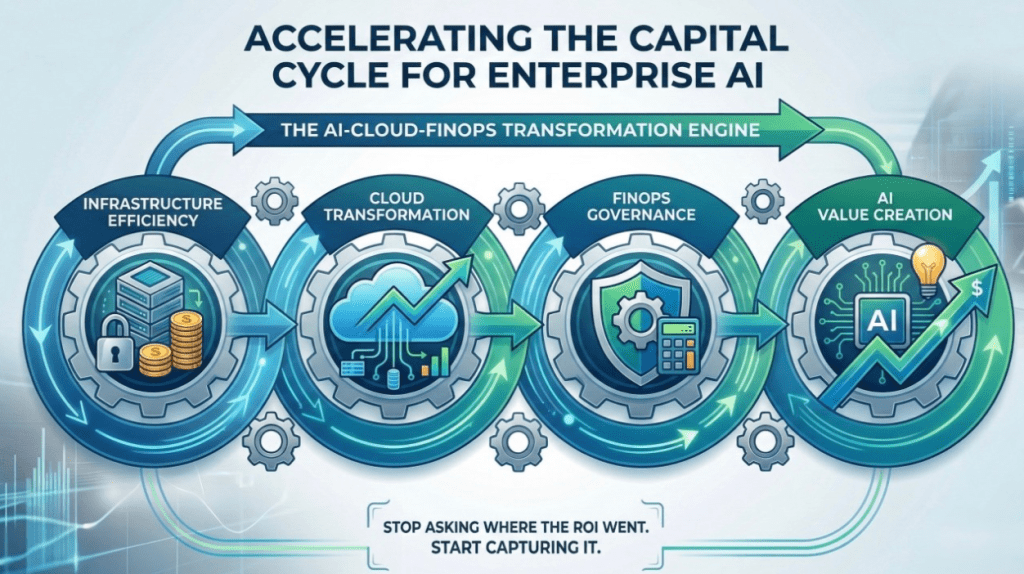
· Infrastructure efficiency creates financial capacity.
· Cloud platforms provide scale.
· Financial governance stabilizes the economics.
· AI delivers the next wave of enterprise value.
Put simply: Infrastructure Efficiency → Cloud Transformation → FinOps Governance → AI Value Creation
Each stage reinforces the next.
Together they form what I think of as an AI Cloud FinOps transformation engine.
Organizations that approach these stages independently often struggle to scale transformation. The organizations that treat them as a system move faster and with far greater confidence.
The Market Is Already Moving This Direction
Recent research reinforces this shift.
The 2026 State of FinOps report gathered feedback from more than 1,100 practitioners representing over $83 billion in annual cloud spend. What stands out most is how quickly FinOps itself is evolving.
FinOps is no longer limited to cloud cost management.
It is expanding across the enterprise technology stack.
Practitioners expect FinOps practices to govern:
· AI spending
· SaaS platforms
· Software licensing
· Private cloud environments
· Data center infrastructure
Nearly 98 percent of FinOps teams expect to manage AI spend within the next two years. SaaS management is expected to reach 90 percent adoption. Even private cloud and data center environments are returning as areas of financial governance.
Perhaps most interesting, 28 percent of FinOps teams are beginning to track labor costs, extending FinOps into engineering productivity and operational efficiency.
In other words, FinOps is becoming the financial operating system for technology.
Infrastructure Efficiency Still Comes First
In my previous post I mentioned a client who asked a simple but direct question.
“We’ve spent heavily on cloud and AI. Where is the ROI?”
At first the answer was not obvious. The technology was there. Teams were experimenting with AI across the organization. Pilots were running in multiple areas.
But the real issue was not the technology.
It was the operating model.
Once we helped them operationalize their approach, introduce governance, and establish the foundations required for enterprise AI, the picture changed quickly. The goal was not simply to deploy AI. It was to make the organization AI ready, so initiatives could scale beyond proofs of concept and into production.
The results followed.
But before any of that could happen, we had to tackle something less exciting but far more important.
Infrastructure and technical debt.
This is where the FinOps data becomes relevant. The latest research shows that 42 percent of FinOps teams still identify workload optimization and waste reduction as their primary focus.
That statistic matters because optimization is not just about saving money.
It creates financial capacity.
Many enterprises still have significant capital tied up in fragmented infrastructure environments. Legacy data centers, underutilized compute environments, and duplicated platforms across regions continue to consume large portions of technology budgets.
The companies moving fastest toward enterprise scale AI are not simply investing more. They are unlocking capital from within their existing infrastructure estates.
Datacenter consolidation, workload rationalization, and infrastructure modernization create the financial headroom required for the next phase of transformation.
Which is why the journey toward enterprise AI so often begins with a much simpler question:
Where does our infrastructure spend trapped?
Cloud Platforms Provide the Scale
Once infrastructure efficiency creates financial capacity, cloud transformation becomes the next step.
Cloud platforms deliver the elasticity, integrated data environments, and compute scale required for modern applications and AI workloads.
But cloud adoption alone does not guarantee efficiency.
Consumption based infrastructure introduces new financial complexity. Without financial discipline, cloud environments quickly become unpredictable.
This is where FinOps begins to shift from a cost optimization discipline to a financial governance model.
FinOps Stabilizes the Economics
As cloud environments mature and AI workloads expand, financial governance becomes critical.
The FinOps research highlights that AI cost management is now the number one skillset FinOps teams are looking to add, cited by nearly 60 percent of practitioners.
This reflects a growing challenge.
AI introduces volatile and unfamiliar consumption patterns.
· Large language model APIs
· GPU workloads
· Vector databases
· Data platform pipelines
These systems scale rapidly but are often difficult to forecast and allocate across business units.
FinOps provides the operating discipline that connects engineering activity with financial accountability.
Organizations that adopt FinOps effectively can establish unit economics for cloud and AI workloads, forecast consumption with greater accuracy, and align engineering decisions with business outcomes.
Without this discipline, AI investment often becomes difficult to manage.
With it, AI becomes scalable.
AI Is Where the Value Materializes
Only after infrastructure efficiency, cloud platforms, and financial governance are in place does AI begin to scale meaningfully.
The FinOps research suggests that by the end of 2026:
Data cloud platforms such as Snowflake, Databricks, and Fabric will be governed by more than 70 percent of FinOps teams.
Large language model providers are expected to reach similar levels of financial governance.
This reflects a broader reality.
AI is rapidly becoming embedded across enterprise operations.
When the foundations are in place, AI moves beyond experimentation and begins producing measurable outcomes.
· Autonomous operations
· Predictive decision making
· Intelligent automation
· AI enabled customer experiences
At that point, AI is no longer an innovation experiment.
It becomes a structural advantage.
The Transformation Engine
Taken together, these elements form a repeatable transformation engine.
· Infrastructure efficiency unlocks capital.
· Cloud platforms enable modern architectures.
· FinOps stabilizes the economics.
· AI delivers enterprise value.
Organizations that understand this capital cycle build systems that allow innovation to scale.
Organizations that treat these stages independently often stall after early success.
Where This Is Headed
The next phase of enterprise technology adoption will not be defined by who experiments with AI the most.
It will be defined by who understands the economics of technology.
· Infrastructure efficiency funds the change.
· Cloud platforms provide the scale.
· FinOps governs the economics.
· AI delivers the value.
Organizations that understand this cycle will stop asking where the ROI went.
They will start capturing it.
 clarivusaiconsulting.com
Leave a comment