Tag: artificial-intelligence

  • Learning & Evolving from the Next Generation: Where Personal Growth Meets Enterprise Transformation | The AI-First Playbook for Channel Partners

    Learning & Evolving from the Next Generation: Where Personal Growth Meets Enterprise Transformation | The AI-First Playbook for Channel Partners

    What’s driving me today isn’t what drove me in the past.

    The time we’re living in right now is incredible, and I’m genuinely grateful to be part of it.

    When I look back, there’s nothing I would change. The tough seasons, the setbacks, the pressure, that’s where the real growth came from. And today, my curiosity is higher than it’s ever been.

    Despite everything I’ve learned, I still want to be the dumbest person in the room. I want to be surrounded by people who are smarter, sharper, and even younger. People who challenge me, push me, and expand how I think.

    A lot of that perspective has been shaped at home.

    My son Oliver, who’s five, inspires me every day. His curiosity, his energy, the way he sees the world, it’s powerful. It’s also a reminder of how much environment matters. Mary Elizabeth and I are intentional about protecting that, because at that age, everything leaves an impression.

    The truth is, he’s teaching me just as much as I’m teaching him.

    That mindset, that curiosity, it’s also what’s pushing me to give back to the community and ecosystem that’s been my professional home for over two decades.

    Some of this may sound familiar, some of it may not, but I’d genuinely value your perspective.

    I wrote in my blog, “THE NEXT ERA OF ENTERPRISE TECHNOLOGY SERVICES: WHY SERVICE PROVIDERS MUST TRANSFORM NOW,” and one thing has become unmistakably clear.

    The need for third-party expertise is not shrinking. It is growing.

    But the expectations of that expertise are changing dramatically.

    Enterprises are no longer looking for pure capacity or traditional outsourcing. They are looking for partners who can help them navigate complexity, orchestrate across multiple platforms, harness AI responsibly, and accelerate modernization outcomes with efficiency and precision.

    This shift is redefining what it means to be a relevant and profitable player in the cloud and security services market.

    I’ve always believed in the partner ecosystem. I believe in building highly technical teams and letting them run to drive innovation, growth, and value. I’ve always told my teams to embrace the partner channel, because it’s better to fish with a net than a pole. That has never been more true, especially as more revenue continues to flow through partners and marketplaces.

    But here’s the conversation I keep having.

    Every VAR I talk to right now is asking:

    “Does AI kill our business model?”

    No.

    Buyer behavior didn’t change because of AI. It changed when cloud and marketplaces gave buyers options they never had before.

    AI is simply accelerating what was already true.

    And that leads to the real issue.

    It’s the wrong question.

    The right question is:

    What do you need to stop doing?

    Stop leading with implementation. You’re competing with hyperscalers who have scale you can’t match.

    Stop getting overly dependent on resell. Keep it, but understand it’s the floor, not the ceiling.

    Stop chasing AI use cases for clients who don’t have the foundation in place. You’ll build something that never makes it to production and wonder why it didn’t stick.

    So what actually works?

    Start with consulting and advisory. Be the person who tells the truth before a client spends millions in the wrong direction. That conversation is worth more than any implementation SOW.

    Run workshops and enablement sessions. Your clients don’t need more technology. They need to know how to use what they already have. That is a paid engagement, not a free pre-sales activity.

    Use AI to build new offerings. Not to replace your team, but to create leverage. A three-person team can operate like a fifteen-person team if done right. The firms that figure this out over the next 12 to 18 months will define the next decade.

    Build an AI-first strategy, but don’t forget the fundamentals of cloud adoption, DevOps, FinOps, and the application development lifecycle.


    So how do you actually become AI-first as a VAR, reseller, MSP, or channel partner?

    Here’s the playbook.

    From Benchmarks to Business Impact: Rethinking AI for Enterprise Adoption

    Most AI evaluation today is academic. It does not translate to enterprise deployment, risk, or business impact.

    If you want to lead in this next era, you have to close that gap.

    1. Start with what’s broken Don’t start with AI use cases. Start with what’s not working. Use your experience to identify friction, waste, and missed outcomes. That’s where AI becomes relevant.

    2. Fix evaluation before scaling AI What’s missing today:

    • Trust
    • Cost visibility
    • Governance
    • Model behavior in production

    If you can’t measure it in the real world, you can’t scale it.

    3. Make AI measurable in production Shift from model performance to business performance.

    • How does it behave in production?
    • What does it cost at scale?
    • Where does it introduce risk?
    • Does it actually change outcomes?

    This is where real value is created.

    4. Build with governance in mind AI governance is about to explode.

    • Regulation is increasing
    • Safety frameworks are evolving
    • Enterprises are demanding accountability

    This is not a constraint. It’s an opportunity.

    5. Operate at the system level You’re not selling models. You’re designing operating models.

    • How AI fits into workflows
    • How it’s governed
    • How it’s evaluated continuously
    • How it scales across the enterprise

    That’s where differentiation happens.

    6. Bridge the gap others can’t Most AI companies build capability.

    Very few understand:

    • How it gets adopted
    • How it fails in real environments
    • How buyers actually think

    That’s where you win.

    7. Focus on outcomes, not experiments Enterprises don’t need more pilots. They need results.

    Tie everything to:

    • Cost reduction
    • Efficiency
    • Risk mitigation
    • Speed

    If it’s not tied to a business outcome, it won’t scale.


    The outcome:

    You move from vendor to advisor. You shift from projects to programs. You build recurring, high-margin services. You position your business at the center of how AI actually gets adopted.

    This is the shift.

    I close the gap between AI capability and real-world trust, adoption, and governance.

    I operate at the system level, not the component level.

    Because if you don’t connect evaluation to reality, you’re solving the wrong problem.

    Some firms are already repositioning.

    The ones waiting are already behind.


    I’ve been having this conversation a lot lately. If you’re a VAR, reseller, GSI, or service provider trying to figure out where you fit in the next chapter, I’d welcome the conversation.

    If this resonates, I’d value your perspective.
  • From Discipline to Acceleration: The Capital Cycle Behind Enterprise AI

    From Discipline to Acceleration: The Capital Cycle Behind Enterprise AI

    In my last post, I wrote about a familiar boardroom moment.

    “We have spent hundreds of millions on cloud and AI. Where is the ROI?”

    That question is no longer rhetorical. It is becoming a mandate.

    The issue is rarely the technology itself. More often, the challenge lies in how organizations have structured themselves around it.

    For years, cloud and AI adoption rewarded experimentation. Teams moved quickly. Pilots were everywhere. Innovation was decentralized.

    That phase is ending.

    What replaces it is something less glamorous but far more powerful. Operational discipline.

    The organizations now extracting real value from cloud and AI are not the ones experimenting the most. They are the ones that have built the operating model required to scale.

    But once that discipline begins to take hold, another realization emerges.

    Transformation requires more than governance.

    It requires an economic engine.

    The Capital Cycle of Enterprise Transformation

    When companies move beyond experimentation and begin executing at scale, a consistent pattern appears.

    ·      Infrastructure efficiency creates financial capacity.

    ·      Cloud platforms provide scale.

    ·      Financial governance stabilizes the economics.

    ·      AI delivers the next wave of enterprise value.

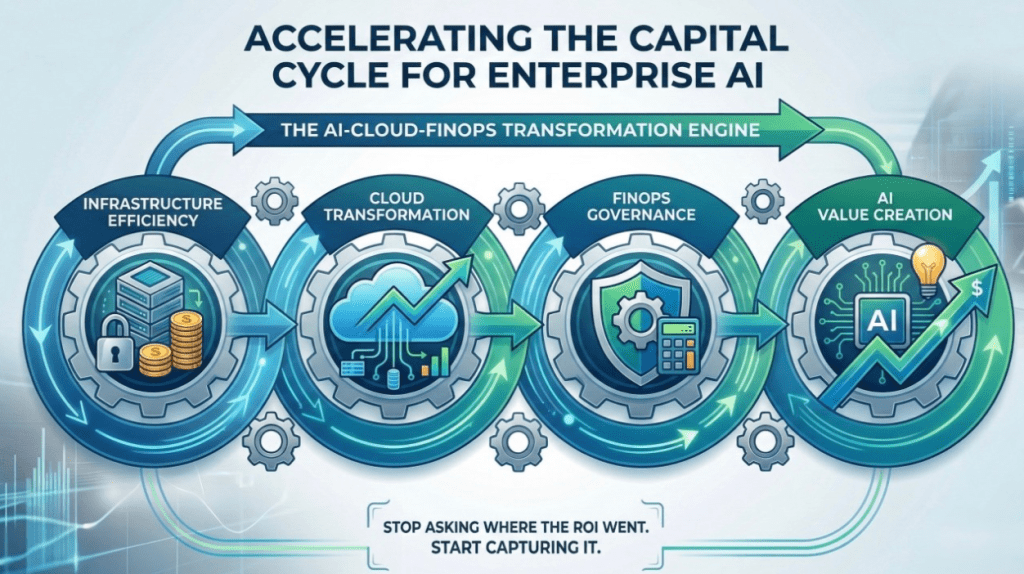
    Put simply: Infrastructure Efficiency → Cloud Transformation → FinOps Governance → AI Value Creation

    Each stage reinforces the next.

    Together they form what I think of as an AI Cloud FinOps transformation engine.

    Organizations that approach these stages independently often struggle to scale transformation. The organizations that treat them as a system move faster and with far greater confidence.

    The Market Is Already Moving This Direction

    Recent research reinforces this shift.

    The 2026 State of FinOps report gathered feedback from more than 1,100 practitioners representing over $83 billion in annual cloud spend. What stands out most is how quickly FinOps itself is evolving.

    FinOps is no longer limited to cloud cost management.

    It is expanding across the enterprise technology stack.

    Practitioners expect FinOps practices to govern:

    ·      AI spending

    ·      SaaS platforms

    ·      Software licensing

    ·      Private cloud environments

    ·      Data center infrastructure

    Nearly 98 percent of FinOps teams expect to manage AI spend within the next two years. SaaS management is expected to reach 90 percent adoption. Even private cloud and data center environments are returning as areas of financial governance.

    Perhaps most interesting, 28 percent of FinOps teams are beginning to track labor costs, extending FinOps into engineering productivity and operational efficiency.

    In other words, FinOps is becoming the financial operating system for technology.

    Infrastructure Efficiency Still Comes First

    In my previous post I mentioned a client who asked a simple but direct question.

    “We’ve spent heavily on cloud and AI. Where is the ROI?”

    At first the answer was not obvious. The technology was there. Teams were experimenting with AI across the organization. Pilots were running in multiple areas.

    But the real issue was not the technology.

    It was the operating model.

    Once we helped them operationalize their approach, introduce governance, and establish the foundations required for enterprise AI, the picture changed quickly. The goal was not simply to deploy AI. It was to make the organization AI ready, so initiatives could scale beyond proofs of concept and into production.

    The results followed.

    But before any of that could happen, we had to tackle something less exciting but far more important.

    Infrastructure and technical debt.

    This is where the FinOps data becomes relevant. The latest research shows that 42 percent of FinOps teams still identify workload optimization and waste reduction as their primary focus.

    That statistic matters because optimization is not just about saving money.

    It creates financial capacity.

    Many enterprises still have significant capital tied up in fragmented infrastructure environments. Legacy data centers, underutilized compute environments, and duplicated platforms across regions continue to consume large portions of technology budgets.

    The companies moving fastest toward enterprise scale AI are not simply investing more. They are unlocking capital from within their existing infrastructure estates.

    Datacenter consolidation, workload rationalization, and infrastructure modernization create the financial headroom required for the next phase of transformation.

    Which is why the journey toward enterprise AI so often begins with a much simpler question:

    Where does our infrastructure spend trapped?

    Cloud Platforms Provide the Scale

    Once infrastructure efficiency creates financial capacity, cloud transformation becomes the next step.

    Cloud platforms deliver the elasticity, integrated data environments, and compute scale required for modern applications and AI workloads.

    But cloud adoption alone does not guarantee efficiency.

    Consumption based infrastructure introduces new financial complexity. Without financial discipline, cloud environments quickly become unpredictable.

    This is where FinOps begins to shift from a cost optimization discipline to a financial governance model.

    FinOps Stabilizes the Economics

    As cloud environments mature and AI workloads expand, financial governance becomes critical.

    The FinOps research highlights that AI cost management is now the number one skillset FinOps teams are looking to add, cited by nearly 60 percent of practitioners.

    This reflects a growing challenge.

    AI introduces volatile and unfamiliar consumption patterns.

    ·      Large language model APIs

    ·      GPU workloads

    ·      Vector databases

    ·      Data platform pipelines

    These systems scale rapidly but are often difficult to forecast and allocate across business units.

    FinOps provides the operating discipline that connects engineering activity with financial accountability.

    Organizations that adopt FinOps effectively can establish unit economics for cloud and AI workloads, forecast consumption with greater accuracy, and align engineering decisions with business outcomes.

    Without this discipline, AI investment often becomes difficult to manage.

    With it, AI becomes scalable.

    AI Is Where the Value Materializes

    Only after infrastructure efficiency, cloud platforms, and financial governance are in place does AI begin to scale meaningfully.

    The FinOps research suggests that by the end of 2026:

    Data cloud platforms such as Snowflake, Databricks, and Fabric will be governed by more than 70 percent of FinOps teams.

    Large language model providers are expected to reach similar levels of financial governance.

    This reflects a broader reality.

    AI is rapidly becoming embedded across enterprise operations.

    When the foundations are in place, AI moves beyond experimentation and begins producing measurable outcomes.

    ·      Autonomous operations

    ·      Predictive decision making

    ·      Intelligent automation

    ·      AI enabled customer experiences

    At that point, AI is no longer an innovation experiment.

    It becomes a structural advantage.

    The Transformation Engine

    Taken together, these elements form a repeatable transformation engine.

    ·      Infrastructure efficiency unlocks capital.

    ·      Cloud platforms enable modern architectures.

    ·      FinOps stabilizes the economics.

    ·      AI delivers enterprise value.

    Organizations that understand this capital cycle build systems that allow innovation to scale.

    Organizations that treat these stages independently often stall after early success.

    Where This Is Headed

    The next phase of enterprise technology adoption will not be defined by who experiments with AI the most.

    It will be defined by who understands the economics of technology.

    ·      Infrastructure efficiency funds the change.

    ·      Cloud platforms provide the scale.

    ·      FinOps governs the economics.

    ·      AI delivers the value.

    Organizations that understand this cycle will stop asking where the ROI went.

    They will start capturing it.

  • From Insight to Execution: Turning Technology Spend into Enterprise Advantage

    From Insight to Execution: Turning Technology Spend into Enterprise Advantage

    Thanks, Jeremy Stano, for helping with this blog.

    In my last post, I talked about a familiar boardroom moment, a simple but direct question: “We’ve spent hundreds of millions on cloud and AI. Where’s the ROI?”

    That question is no longer rhetorical. It’s becoming a mandate.

    What I want to focus on here is what happens after that realization, when organizations accept that the problem isn’t the technology itself, but how they’ve organized around it.

    Because the difference between companies that extract real value and those that stall isn’t innovation velocity. It’s operating discipline.

    The Shift Leaders Are Now Being Forced to Make

    Many enterprises are at an inflection point. The early phases of cloud and AI adoption rewarded experimentation, speed, and local autonomy. That era is ending.

    What’s replacing it is something less glamorous but far more powerful, enterprise intent.

    • Leaders are being forced to move from:
    • Experimentation to execution
    • Pilots to platforms
    • Localized wins to enterprise leverage

    This is uncomfortable because it requires giving up the illusion that more tools, more vendors, or more use cases will somehow add up to transformation.

    They don’t.

    Transformation happens when organizations decide how they want to operate and then force technology decisions to align with that model.

    And this is where many strategies begin to break down.

    Why “Scaling” Is Where Most Strategies Break

    Most technology strategies fail not at ideation, but at scale.

    AI pilots work. Cloud migrations complete. Dashboards light up. But when leaders try to scale those successes across regions, business units, and functions, friction shows up everywhere:

    • Inconsistent data definitions
    • Unclear ownership
    • Duplicated spend
    • Security and compliance concerns
    • Cost structures no one fully understands

    At that point, technology becomes a tax on the business instead of a lever.

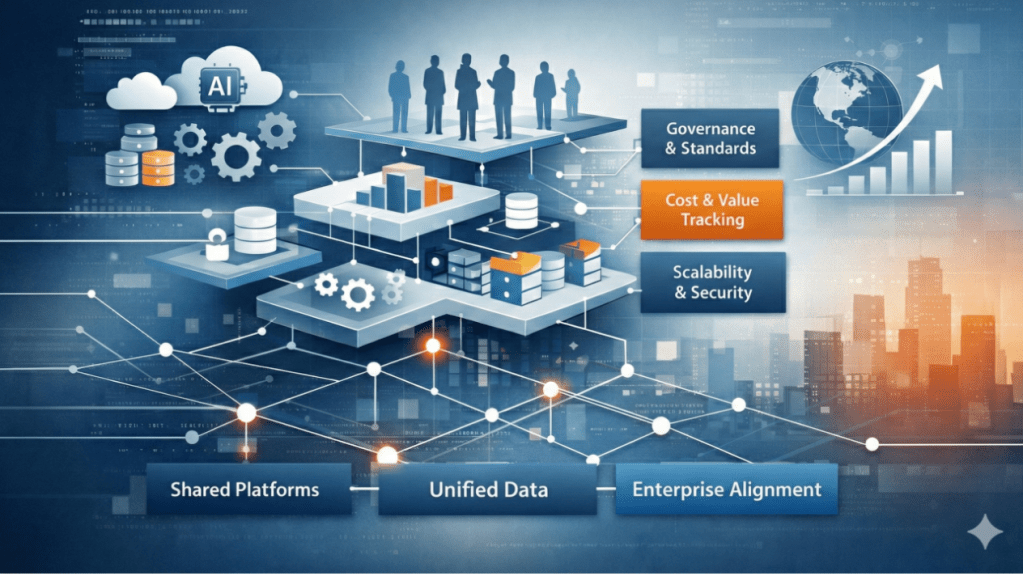
    The organizations that break through this phase do something counterintuitive. They slow down to standardize.

    They establish shared platforms, common governance, and repeatable delivery models before chasing the next wave of innovation. That discipline is what allows them to move faster later, with confidence.

    The Enterprise Questions That Matter Now

    What I’m seeing in executive conversations has shifted. The questions are no longer:

    • Can we deploy this?
    • Is the technology mature?

    They’re now:

    • Who owns this end to end?
    • How does this scale without multiplying cost and risk?
    • How do we measure value consistently across the business?
    • What stops this from becoming another siloed initiative?

    These are not IT questions. They are operating model questions.

    And once leaders accept that framing, their behavior starts to change.

    What the Strongest Organizations Are Doing Differently

    The enterprises that are pulling ahead share a few clear patterns.

    They treat cloud economics and AI readiness as executive responsibilities, not technical afterthoughts. Financial transparency, cost accountability, and value tracking are built in from day one, not bolted on later.

    They invest in platforms over point solutions. Whether it’s data foundations, AI enablement, or automation, they prioritize reusable capabilities that can serve multiple business outcomes, not one-off use cases.

    They align partners to operating outcomes, not tools. The most effective partnerships are those that reinforce enterprise standards and delivery models, not introduce more fragmentation.

    And critically, they are willing to say no to initiatives that don’t fit the model, even if the technology itself is compelling.

    Where This Is Ultimately Headed

    The next phase of enterprise technology adoption will not be defined by who experiments the most. It will be defined by who can operate at scale with discipline.

    Cloud, AI, and automation are no longer emerging capabilities. They are core infrastructure for how modern enterprises compete. That means they must be governed, measured, and evolved with the same rigor as any other mission-critical business platform.

    The organizations that recognize this, and act accordingly, will stop asking where the ROI went.

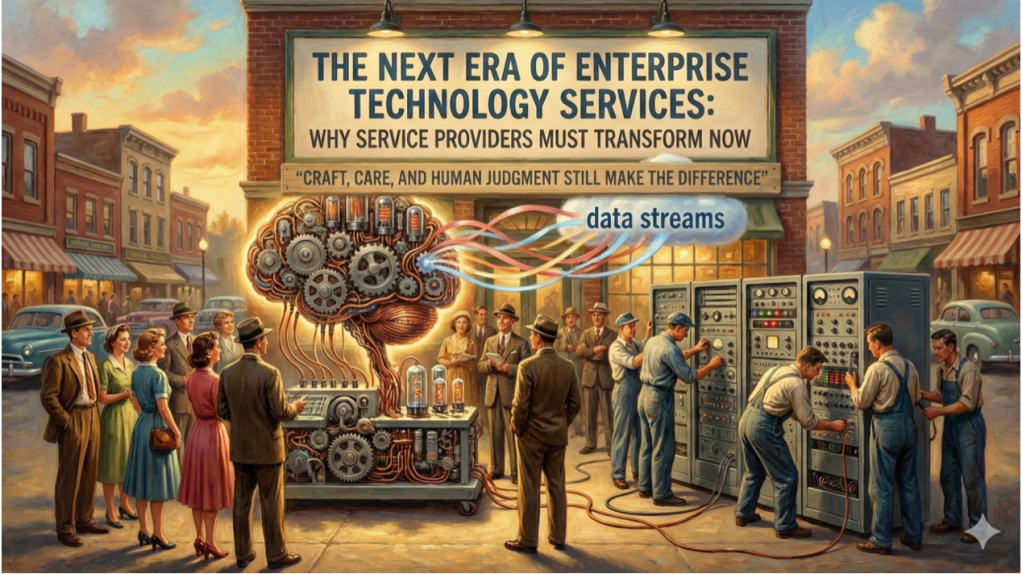
  • “THE NEXT ERA OF ENTERPRISE TECHNOLOGY SERVICES: WHY SERVICE PROVIDERS MUST TRANSFORM NOW”

    “THE NEXT ERA OF ENTERPRISE TECHNOLOGY SERVICES: WHY SERVICE PROVIDERS MUST TRANSFORM NOW”

    Craft, care, and human judgment still make the difference”

    The cloud and security landscape is entering one of the most transformative periods in its history. Enterprises across every industry are accelerating modernization initiatives, adopting AI at unprecedented speed, and embracing multi-cloud architectures as the new normal. As technology evolves, so does the role of the global service provider.

    One thing has become unmistakably clear.

    The need for third-party expertise is not shrinking. It is growing.

    But the expectations of that expertise are changing dramatically.

    Enterprises are no longer looking for pure capacity or traditional outsourcing. They are looking for partners who can help them navigate complexity, orchestrate across multiple platforms, harness AI responsibly, and accelerate modernization outcomes with efficiency and precision. This shift is redefining what it means to be a relevant and profitable player in the cloud and security services market.

    Here are the major forces shaping the next era of transformation.

    1. Enterprise Adoption of AI Is Reshaping Expectations and Economics

    AI has quickly evolved from an innovation topic to a foundation of modern IT strategy.

    Organizations are now exploring enterprise AI to transform operations and customer experience, agentic AI that can autonomously execute processes, and AI orchestration across multiple clouds to ensure portability, performance, and governance.

    As AI becomes central to business outcomes, service providers are expected to deliver more than implementation skills. They must understand data architecture, governance, security, compliance, and cross-cloud operational models. Just as importantly, they must integrate AI into how services are delivered, not simply what is delivered.

    This shift has direct economic implications. AI-enabled delivery models are changing margin structures by reducing labor intensity, increasing repeatability, and shifting value toward intellectual property, platforms, and advisory-led engagements. Providers that embed AI into delivery can scale revenue without scaling headcount at the same rate, while those that do not will see margin compression as clients demand more outcomes for less cost.

    The market is moving toward AI-first service models where efficiency, speed, and intelligence are built into the delivery fabric. That transition is no longer optional if providers want to protect and expand profitability.

    2. Multi-Cloud Is No Longer a Strategy, It Is an Operating Reality

    For years, multi-cloud was aspirational. Today, it is operational reality.

    Recent developments, including deeper network-level collaboration among hyperscalers, highlight how quickly cross-cloud capability is advancing. Enterprises are adopting multi-cloud architectures to improve resilience, leverage the strengths of different platforms, meet regulatory and data residency requirements, and support AI workloads that span environments.

    This reality creates a new mandate for service providers. They must design, orchestrate, and secure environments across multiple clouds, not just optimize within one.

    From an economic standpoint, this raises the bar. Multi-cloud delivery increases complexity, but it also increases opportunity for providers that can standardize architectures, centralize governance, and deliver consistent outcomes across platforms. Those that fail to do so will see rising delivery costs and shrinking margins as complexity overwhelms traditional models.

    3. The Rise of Sovereign Cloud and New Compliance Models

    Countries and regions are redefining expectations around digital sovereignty, privacy, and AI governance.

    As regulatory pressure increases, enterprises will rely more heavily on partners who can design sovereign cloud architectures that balance compliance, performance, and innovation. This reinforces the need for deeper expertise and tighter integration between cloud, security, and governance capabilities.

    For service providers, sovereign cloud is not just a compliance play. It is a differentiation and margin opportunity for those that can operationalize it at scale, and a margin risk for those that treat it as a one-off exception.

    4. Marketplaces Are Becoming a Primary Channel for Technology and Services Consumption

    Enterprise procurement is undergoing its own transformation.

    AWS, Azure, and Google Cloud marketplaces are rapidly becoming preferred channels for purchasing software and services. The appeal is clear. Streamlined contracting, the ability to use committed cloud spend, faster time to value, and centralized governance.

    For service providers, this shift fundamentally changes go-to-market economics. Offerings must be productized, pricing must be transparent, and delivery must be repeatable.

    The opportunity is significant. At re:Invent, AWS highlighted that for every one dollar of cloud consumption, leading partners are generating seven dollars of related services revenue, per the Omdia Partner Ecosystem Multiplier: The AWS Opportunity 2025. Providers that align their offerings to marketplace consumption models are better positioned to capture this multiplier. Those that do not risk being bypassed as procurement consolidates around marketplace-first motions.

    5. Emerging Technologies Are Creating New Frontiers and New Cost Curves

    The next wave of innovation is already unfolding.

    Organizations are beginning to explore quantum computing, Web 3.0 and decentralized trust models, advanced identity and tokenization, and autonomous operations.

    While many of these technologies remain early, they will introduce new cost structures, new governance challenges, and new expectations of service providers. The providers that begin preparing now, by investing in skills, platforms, and partnerships, will be better positioned to monetize these capabilities later. Those that wait will face higher entry costs and steeper learning curves.

    6. The Economics of Services Are Being Redefined

    Across all these trends, one theme stands out. The economics of services are changing.

    Traditional labor-based models struggle under the weight of rising complexity, margin pressure, and client expectations for speed and outcomes. The providers that thrive will be those that evolve toward AI-powered, cloud-first, multi-cloud-capable, and security-centric operating models.

    This evolution directly impacts profitability. Providers that successfully transform can increase revenue per engagement, improve delivery margins, and create more predictable, scalable services revenue. Those that fail to adapt will see shrinking margins and declining relevance as clients consolidate spend around fewer, more capable partners.

    What This Means for the Future of Service Providers

    The message for the cloud and security ecosystem is clear. Standing still is not an option.

    The next twelve to twenty-four months represent a tipping point. Enterprises are already consolidating partners, rationalizing vendors, and favoring providers that can operate at scale with discipline. Providers that lag in transformation are beginning to feel the impact through pricing pressure, reduced deal sizes, and exclusion from strategic conversations.

    Enterprises will continue to rely heavily on third-party expertise, but they will expect smarter, faster, more integrated solutions. They will expect partners who embrace AI in both offerings and delivery, understand cross-cloud complexity, guide modernization and governance with confidence, support marketplace-led procurement models, and prepare for emerging technologies now, not later.

    What This Means for the Role of the Partner

    Those advances are transformative. But even with all this progress, the need for a partner who can help clients harness technology to drive real business outcomes is only growing. Not a partner that delivers boardroom PowerPoint, but one that dives in, develops, builds, enables, and provides the right level of platform and orchestration.

    That is what allows clients to choose the right solutions for their goals and objectives, uncover new areas of growth, and identify opportunities to reduce complexity and optimize their technology stacks. The result is less effort, more streamlined operations, and outcomes that scale.

    At the center of it all, the human still matters. Technology will not replace human intuition or the craftsmanship that only comes from experience and artistry. It’s the same reason, standing in front of a hand-painted piece of art, or hearing a live pianist play carries the same feeling as a handcrafted sports car or a custom suit. You can feel the difference immediately. That value, that difference, it still

    matters, and it always will.

    The providers who make this shift will remain relevant.

    They will expand margins, strengthen client trust, and lead the next era of cloud and security services.

    Those who do not will find that the market has already moved on.

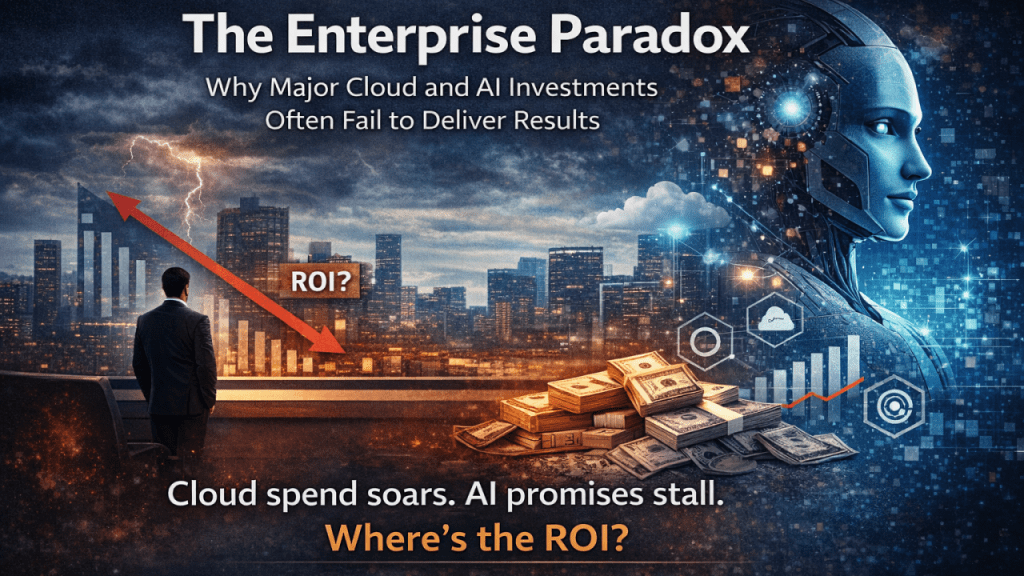
  • The Enterprise Paradox: Why Major Cloud and AI Investments Often Fail to Deliver Results

    The Enterprise Paradox: Why Major Cloud and AI Investments Often Fail to Deliver Results

    A candid discussion on bridging the gap between technology spending and business impact.

    The Boardroom Challenge

    Last month, I sat in a boardroom with a Fortune 1000 CXO who asked a question I hear increasingly often. I am paraphrasing, using a general dollar amount, but it still represents the sentiment:

    “We’ve spent $200 million on cloud and AI initiatives. Where’s the ROI?”

    The silence that followed wasn’t about failure. It reflected a fundamental disconnect between technology investment and impact measurement, a challenge present in nearly every large enterprise today.

    Executives are realizing that substantial cloud and AI investments aren’t automatically delivering the expected business outcomes.

    The technology works. The teams are capable. Yet the returns remain elusive.

    The Multi-Cloud Mirage

    A lot of the CXOs/leaders I am talking with are facing an uncomfortable reality: significant investments in AWS, Azure, and GCP haven’t produced the business clarity they expected. Teams generate mountains of cloud cost and utilization data, stay busy with optimization projects, and maintain strong vendor relationships. Yet leadership still struggles to answer basic questions about value creation.

    The root cause? Cloud spending is fragmented across business units, regions, and product lines. Tagging standards are inconsistent. Governance exists in pockets but not holistically. Most critically, there’s no clear line of sight between cloud expenditure and business outcomes.

    We witness a similar adoption and implementation curve with DevOps. Everyone was buying DevOps tools but not implementing the operational rigor or culture of a true DevOps strategy. Why? Because it’s difficult—however, when DevOps is implemented, it’s transformative. The blog from Bunnyshell back in 2021 provided a great view on this as well. https://www.bunnyshell.com/blog/challenges-of-devops/

    Let me give you an example: one global manufacturing client discovered they were spending 40% more on cloud infrastructure than necessary. The problem wasn’t technical inefficiency but organizational: no unified visibility into what was being purchased and why. Different teams were solving the same problems independently, duplicating costs, and creating vendor lock-in without strategic intent.

    Simply put, the rise of advanced technology with huge upsides always requires effort — but at scale, transformational work is hard. It’s supposed to be. If it were easy, it wouldn’t be transformational.